Monday, February 9, 2009

History of Mexican Tattoos


The History of Mexican Tattoo
aztec calendar

Contrary to common belief, Mexican tattoos began long before the stereotypical ideas about them – the idea that Mexicans have only been tattooing for a hundred years or so is a misconception. Tattoos in the Mexican culture date back to the early 1300s and perhaps before that. Both the Aztecs and the Mexica, along with other Mexican native tribes used tattoos as ornamental and as a way to intimidate foes during battle.
[edit]
Types of Mexican Tattoos

As with other cultural artwork, Mexican tattoos come in many different categories. The tattoos that originate or that are inspired by this culture are as varied as the landscape of the country itself.
* Aztec Pride
* Regional Pride
* Chilango Pride

1. Many Mexicans have a strong sense of their “original” roots. The origins of the Mexica and Aztec are more important to this sect of Mexicans than any other group that makes up the culture, mainly Spanish. Most native Mexican designs include the sun and sun god, other astrological symbols and symbols of sacrifice. Aztec tattoos focus on symbols important to these North American natives, including the Aztec dagger. Other designs, including sun tattoos focus heavily on astronomical symbols and natural forces. The Aztecs were a fierce people who held their ground and believed strongly in a higher creator. The Aztecs depicted deities in glyphs that can be seen across modern day Mexico City and many regions of central and southern Mexico.
2. Probably the largest genre of Mexican tattoos are regional pride tattoos. Mexicans from certain provinces of Mexico, including Oaxaca, Michoacán, Sonora and Chihuahua are especially proud of their heritage. Many Mexican tattoos of this nature will include backgrounds of the shape of a particular region along with a foreground of a family crest or family surname.
3. Chilango is a Mexican term that refers to a person from Mexico City. Those from the capitol city are proud of both their Mexica and Spanish roots. Mexican tattoos in the Chilango genre will mainly contain images that depict the legend of the eagle and snake as well as images of Huitzilopochtli, the sun god of the Mexica. Even today the legends that were brought forth by the Mexica shape the Mexican culture – the flag of the nation itself depicts the legend of the eagle and snake that helped to lead the Mexica to what is now the capitol city. Those who get a simple tattoo of the Mexican flag are incorporating these historical images as a way to remember where they came from.
Mexican political tattoos can be broken into a few categories:

* Mexican Pride in America -

Many Mexicans who have migrated into the United States for work or family have found the strong resistance from those who oppose their presence. They fight what they perceive to be oppression with art as many cultures have throughout the ages. Often times, Mexican pride tattoos will feature symbols of the convergence of the Mexican and American flags, as if to promote better relations through communicating rather than fighting what is presumably a losing battle for both countries.

* Anti-INS or La Migra -

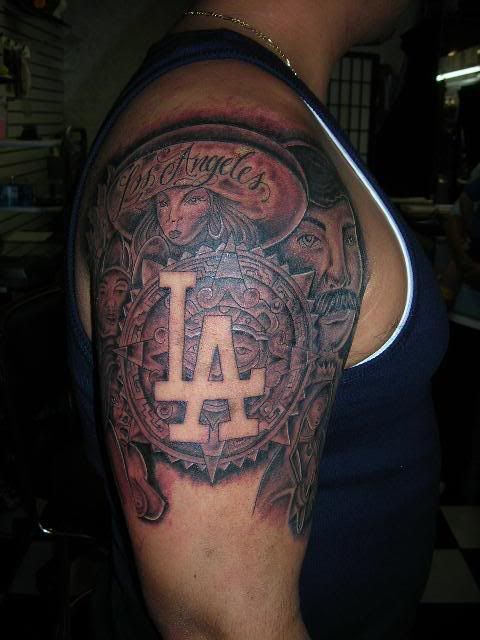
Anti-INS tattoos are especially popular in Los Angeles and Mexican-American border towns where “La Migra” endeavors to keep illegal aliens out. Once in, however, migrant workers proudly provide for their families who continue to reside in Mexico. Many of these immigrants will get a tattoo to remember their families and why they came to the United States. Many migrant workers will also get portrait tattoos of wives or children they left behind.

* Pro right-to-work with strong ties to Cesar Chavez and other pioneers in this fight for labor freedoms -

Many Mexicans, especially those who have won the right to legally be employed in the United States will continue to protest in the name of worker freedoms. Along with this revolutionary attitude come tattoos depicting Cesar Chavez and other leaders of Mexican labor movements, such as Dolores Huerta.
cross tattoo
Many Mexicans both residing in the United States and Mexico have strong religious beliefs, generally Mexican religious tattoos focus on religious figures of the Roman Catholic church - including Christ, various saints and predominantly, the Virgin Mary, known in Mexico as La Virgen de Guadalupe. Most Mexicans hold a special place in their hearts for the Virgin and believe that she is often disregarded by Catholics of Anglo-Saxon decent as well as other Christians who focus more on Jesus. Many Latino and Chicano prison tattoos feature religious symbols as well.


Source : http://tattoos.lovetoknow.com/Mexican_Tattoos

Hispanic Tattoos Designs


Mexican tattoos have come a long way from the stereotype gang tattoos that most people wrongly associate with Hispanics and their culture. Although gang tattoos are quite extensive they have even made it into mainstream street culture with sexy Latinas, chicas and wannabe homeboys adopting this gangbanger style.

Many Mexican tattoos such as these will have gang or criminal affiliations such as the number 13 which signifies the 13th letter of the alphabet, the letter M, meaning La Eme or The M; the Mexican Mafia. Or the three dots usually found on the hand beween the thumb and forefinger which has come to mean Mi Vida Loca or My Crazy Life. But Mexican tattoos aren't all about gangs or prison time.

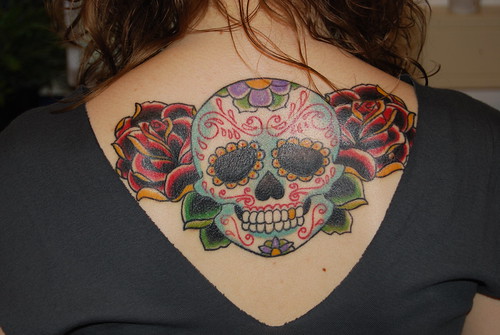
Mexican tattoos are often depicted with skulls such as in the Mexican Day of the Dead. Fineprint by Anna.

'Mexican Day of the Dead' inspired design © Anna at Annagram

Mexico is predominantly a Catholic country and this has had a major influence in the style of tattoos worn by many Mexicans. Images of the Virgin Mary and Jesus Christ are quite popular. There are many variations of the Virgin Mary depicted as an apparition or protective mother. Similarly Jesus is often depicted in the classic Sacred Heart tattoo or depicted on a cross.

Cross tattoos are hugely popular amongst Mexican males in particular. The usual place to have them done in on the chest or covering the entire back. For females the depiction of the Sacred Heart on the chest is another popular style.

With such a rich history in Mexico you would expect that Aztec or Mayan tattoo designs would be quite prominent. The Mayans and Aztecs were renowned for their body art yet this is not really the case in Mexico. As you would expect the majority of people who request these types of designs are not of Hispanic origin. Go figure!


Source : http://www.tao-of-tattoos.com/mexican-tattoos.html

Aztec and Mexican Tattoos


Mexican tattoos are some of the most striking new patterns around. They take their themes from those of ancient Mayan, Inca and Aztec art, a very distinctive look that’s different from most other types of tattoo designs, yet instantly recognizable.The bold, geometric patterns of Mexican tattoos make them very well suited to tattoo art.

Ancient Aztec Tattoos

Mexican Tattoos

Mexican Tattoo

The Aztecs were a tribe that lived from the 13th to the 16th century in and around the area that is now called Mexico. Religion and the many gods were very important in the Aztec culture, a lot of the daily life of the Aztecs was meant to honor and please the gods.

Tattooing played an important role in the Aztec culture though, even children were tattooed.

The ancient Aztec tattoo designs were rather rudimentary, and were not only designed to decorate the body, but for a variety of reasons:

  • Aztec tribal tattoos were done during rituals and always in honor of a specific god.
  • Tattoo designs were used to differentiate between the different tribes.
  • Aztec tattoo designs were used to mark a person’s status, to show a warrior's rank and accomplishments.

There are several tattoo designs that we commonly see with regard to Aztec and Mexican tattoos:

  • Many Aztec tattoo designs involve the sun in one way or another. Sun tattoos were in honor of Huitzilopochtili, the Aztec sun god. The sun was very important to the Aztec people, it was the guardian of the heavens. That's why today, an Aztec sun tattoo symbolizes belief in an afterlife.
  • Quetzalcoatl – the feathered serpent god of ancient Mexico – has also been adapted to Mexican tattooing. Quetzalcoatl, the god of weather, creativity and fertility, was the most powerful of all Aztec gods.

    Aztec Tattoos

  • Tezcatlipoca, the god of warriors.
  • The Aztec calendar is a nice design for a tribal tattoo. Here's a video of an Aztec calendar tattoo in the works:
  • Eagle: Aztec warriors drew strength from the eagle.
  • Other Aztec tattoos that are popular today are cross tattoos and sun & moon tattoos.

Nowadays people are interested in Aztec tribal tattoos because of their symbolic meaning, to honor their heritage or because they feel a connection with the ancient and powerful culture of the Aztecs.


Mexican Prison and Gang Tattoos

On the other hand, one type of Mexican or Hispanic tattoo has been current for some time, and that is the gang or prison related tattoo. These tattoo designs often feature:

  • Ornate tattoo lettering.
  • Christian (specifically Catholic) images. These include images of certain saints, the Virgin Mary, as well as cross or Christ imagery.

Examples of Mexican mafia tattoos include:

  • An eagle with a snake in its mouth, standing on the initials EME.
  • A black hand.
  • MM: Mafia Mexicana.

Other Mexican Tattoo Designs

Nowadays, there’s much more to Mexican tattoos than a prison or gang related design. Mexican style tattoos are among the most beautiful and original new tattoos designs today.

  • Mexican skull tattoos: inspired by the Mexican Day of the Dead, a holiday in which the Mexican people remember those who have died.


  • Mexican pride tattoos: a lot of Mexicans work in the United States, away from their origins. To honor their heritage and show their Mexican pride, some adorn themselves with for example a Mexican flag tattoo.

Before you decide on a Mexican tattoo design, do a bit of research about the mythology that engendered it, and the precise meaning of the image you are choosing. After all, you will be living with this image for the rest of your life (at least until the cost of tattoo removal comes down a bit), so you want to make sure that it resonates with you – in more ways than just appearance.

Some of Aztec, Maya and Inca mythology is inspiring, but some of it tends to be a bit dark, so you need to make sure that you don't end up with an image whose meaning you aren't completely comfortable with!


Source : http://www.freetattoodesigns.org/mexican-tattoos.html


Tuesday, February 3, 2009

The Chinese Tattoos Symbols, Designs, Ideas And Themes


Recently there's been a huge rise in the field of tattooing. With popular TV shows like Miami Heat in LA Inc. being broadcast on national TV more and more people are getting tattoos. Of particular fascination to many are Chinese tattoo symbols and designs. The art of tattooing in China actually dates back much farther then its western counterpart. In the West until he didn't come into fashion until very late in the 20th century and mainly in the early 21st century. However, the art of tattooing has a long history in many Asian cultures including China, Japan, and even Thailand just to name a few. What is ironic about this is typically tattoos are used in many of the Asian cultures to mark criminals and other social deviants.

Regardless of the past Chinese tattoo symbols have been widely adopted into the western tattoo lexicon. The mystique and foreignness of an Asian tattoo and the beauty of Chinese and Japanese writing have really sparked a lot of interest among western tattoo enthusiasts. There are many beautiful Chinese designs of themselves well to the art of tattooing. However in much of Asia since tattooing was done in criminals and social deviants many of the designs are very large and often full body pieces especially in Japan. These often are very expensive designs and take many hours in a tattoo shop this is led many western tattoo enthusiasts to opt for Chinese symbols. The beautiful script used in China lends itself well to creating a mysterious and ancient looking tattoo that is not easily discernible by the average Westerner.

The most common Chinese tattoo symbols that are sought after are often representative of important values. For example a simple word that represents themes like love, strength, or power. Another common theme among western tattoo enthusiasts is to seek a translation of something important in the Chinese. For example it's very common for men and women alike to get the names of their children translated into Chinese and the tech to them on their shoulders arms or back.

For those wishing to embellish their tattoo their many smaller themes designs they can easily accompany Chinese Japanese writing a script. For example, men will getting Tiger, lion, or dragon to accompany their design. Women tend to opt for a more delicate designs such as the cherry blossom, yin yang symbol, or a koi fish design.

There are a wide variety of very beautiful tattoo designs throughout Asian cultures. Anyone considering getting a Chinese or Japanese tattoo would be well advised to check their overall design especially the writing with a native speaker of the language. Their many incidents where a person is purchased a flash tattoo at a local tattoo shop thinking that it meant one thing later find out that that's a totally different.

The Vanishing Tattoos of the Li People


The Li, comprised of five tribes, are the indigenous inhabitants of Hainan Island, China. It is believed that they migrated here more than 2,000 years ago from the mainland.

The island of Hainan has approximately the same geographical area as Taiwan and lies at the same latitude as Hawaii. The word "Hainan" means "South of the Sea," but the Chinese likewise call their far southern possession "The Tail of the Dragon"; a wild place at the end of the Chinese world that at one time or another was considered more remote and mysterious than Tibet or Mongolia.

The Li are one of fifty-five classified minority peoples of China, and by the 15th century Han Chinese immigrants began driving the Li into the southern mountains and forests forcing them to abandon their traditional settlements on the coastal plains of Hainan Island. With the establishment of the People’s Republic of China in 1949, the communist government - adhering to an atheistic ideology - implemented policies of pochu mixin (eradicating superstitions) and yifengyisu (change prevailing customs and transform social traditions) that quickly collapsed the animistic religion of the Li: one that was based on ancestor worship and shamanism, as well as other salient cultural institutions including music, weaving, and tattooing.

Yet it was the rapid decline of the Li economy, one based on the swidden agriculture of rice, that brought virtual extinction to the sociocultural milieu. Because land, the element in which the divine, mythic, and ritual components of life were deeply embedded, bound the Li together into a social fabric that was intricately woven within an integrated system of belief. This form of environmental enchainment engendered a form of life experience that was accreted collectively, since everything in the surrounding environment bore witness to Li existence, including physical and mental attributes, as well more metaphysical practices such as tattooing which were believed to carry individuals into the afterlife.
LI RELIGION

As noted, the Li were animists. They were guided in their spiritual affairs by shamans. Li shamans, through their communications with spirits, deities, and ancestors, functioned as mediators between the physical and supernatural realms. They could harness supernatural power to assure victory in war, hunting, and curing the sick. But the spiritual favors that were granted to successful mediators could only be achieved through the proper channels: that is if the spirits of the mountains and ancestors were properly "fed" by the shaman with sacrifices to gain their favor. If, however, the spirits were not properly propitiated, they often turned aggressive and malevolent towards humans and brought sickness or misfortune to the village.

The Li concept of sickness was not, as in the West, attributable to bad health; it was a form of punishment, or a disruption of the social order, caused by not fulfilling social duties correctly. Sometimes sacrifices to the spirits were made in blood and were connected to the former Li practice of headhunting. Shamans not only captured the human blood for use in ritual, they also prepared the severed heads of slain enemies for burial near the entrance to the village, which was supposed to transform the spirits of the "war-dead" into guardians of the community.

Although Li shamans were highly respected, their economic position in society was similar to the layperson because they regularly worked the rice fields just as others did. Here in the rice fields, the entire family unit worked together to transplant the rice plants and to harvest the crop. Oftentimes relatives from other villages provided additional labor and this collective agency not only established expansive socioeconomic networks linking households and villages for great distances across the Li landscape, but also provided a spiritual platform from which to petition the deities who controlled it.

Women working the fields sang various songs in a harmonious fashion. And in these songs, the names of the spirits of the mountains and trees were invoked to beg their pardon from being disturbed as the soil was tilled. In the eyes of the Li, all musical expression, including performance with musical instruments, was a powerful medium that assisted humans in communicating with the spirits who protected the crops. And more importantly, skillful performance pleased the ancestors for it reproduced their agency and therefore memory in a cyclical perception of time.
Basadung Li hand and leg tattoos, ca. 1930.
Basadung Li hand and leg tattoos, ca. 1930. It was not appropriate for a Basadung Li woman to have her hands tattooed until she was married. According to the German ethnologist Hans Stübel, the origin of Li tattooing lay in legend: “The progenitor of the Li had a daughter, whose mother died shortly after the birth of this child. Whereupon a hoopoe (Upupa epops) fed the child with grains. In remembrance, the Li women still tattoo themselves in order to appear to be as colorful as birds. Perhaps, the tattoos should represent the pattern on the wings of the hoopoes.”

Drawings of Basadung Li women’s body tattooing.
Drawings of Basadung Li women’s body tattooing. During Stübel’s visit to Hainan Island in the early 1930s, only vestiges of particular forms of tattooing were to be seen. According to Dr. Philip Xie of Bowling Green University, facial tattooing is extremely rare on Hainan Island today. Dr. Xie has only seen arm and leg tattoos during recent visits to several Li villages.


Geometric tattoos of a Basadung Li woman, ca. 1930.


Geometric tattoos of a Basadung Li woman, ca. 1930.


Basadung Li woman weaving a tubeskirt with backstrap loom
Basadung Li woman weaving a tubeskirt with backstrap loom, ca. 1930. As early as the 1st century B.C., it was recorded that Li women produced homespun cotton which was then dyed and woven into garments. During the Qing Dynasty, Li brocade was considered to be “as fascinating as clouds” incorporating birds, insects, animals, flowers, stars and other celestial objects into exquisite patterns.

Meifu Li facial tattooing, ca. 1930.


LI TATTOOING

Li culture and cosmology, however, were not only embodied in musical traditions; they were also inscribed on the surfaces of the body as tattoo. All Li groups tattooed and the practice was more common among women, although men tattooed three blue rings around their wrists for medicinal purposes. Tattoo designs and motifs differed between each tribe, and sometimes they differed among families. One writer working for the National Geographic Magazine in the 1930s said you could “read the village, social standing, and identity” through a woman’s tattoos; her woven textiles supposedly imparted similar information.

When a Li girl of the Basadung tribe reached the age of thirteen or fourteen an old women, who was not necessarily a relative, first tattooed her on the nape of the neck and then on the face and throat in the course of four or five days. Over the next three years, her arms and legs were marked, unless somebody in the family died which interrupted the tattooing. The designs were stenciled on the skin with Chinese ink; then a thorn was used to prick the skin, followed by the rubbing of soot mixed with water into the wounds.

The Meifu basically adhered to the Basadung practice while other groups created a chin tattoo that extended down the throat in two pairs of lines. These pairs of lines continued down the torso and across the breast moving downwards again to the belly meeting at the navel which they encircled.

Li tattoos signified that a woman had become eligible to be married and traditionally the ritual was accompanied by an elaborate puberty ceremony in the village center. Li women interviewed in the 1930s said their tattoos not only made them beautiful, but allowed them to be recognized by their ancestors after death.
VANISHING TATTOOS

Today, contemporary Hainan is no longer the remote and mysterious wilderness situated at "The Tail of the Dragon." Traditional tattoos are now only worn on the bodies of a few elderly women in a handful of villages. Yet as these enduring fragments remain, they allow us to partially glimpse an indelible past shaped not by one hand but by many over successive generations of cultural practice that at one time connected ritual, myth, and nature from which Li tattoo culture ultimately sprang.


Source : http://www.vanishingtattoo.com/hainan_island_tattoos.htm

Tattoos scar generation of Chinese women Today


HAINAN ISLAND, China, April 9 (Reuters Life!) - The tattooed women of China are a dying breed.

A coming-of-age ritual that guaranteed marriage, tattooing for the women of the Li tribe, who live in remote areas of the southern resort island of Hainan, has now become an undesirable, ugly practice that limits chances for success in modern times.

For the Li, whose history spans more than 2,000 years, the tattoos were talismans against evil, a way to make their women ugly to foreign kidnappers but beautiful to their own kin.

Marriage was unthinkable before the girl's entire body had been covered in a series of intricate geometric lines and dots in a painful and painstaking process that involved piercing the skin with thorns and then rubbing soot and water into the wounds.

The ritual would take a whole week -- one day for each part of the body, starting from the face.

Patterns were passed down through generations, and similar designs were woven into homespun textiles.

But the practice was stopped in the 1960s when the Li women began to discover that their prized body art was actually ostracizing them from society.

Fu Renmei is one of the last generation of Li women to be tattooed. She went through the ritual aged 13.

"I was happy! Why? Before, if you didn't have tattoos then your boyfriend would not marry you. My grandmother told me that girls who didn't tattoo would be kidnapped. If you are tattooed you will look ugly so you will be safe," she said.

Fu Wenying, 58, was the first among her girl friends to get tattooed, and consequently was the first to get married. Memories of her tattooing ceremony are still painfully fresh.

"I would never go back and do it again, it was too painful. I would not want to go through that again," she said.

Her daughter, Fu Yingwu, says she would never consider getting a tattoo, since in today's China, they are an obstacle to getting a good job, especially in a resort in Hainan.

"I would never want to tattoo because now everyone likes white, unblemished skin. Why would I want to look like an old person with dark skin?," Fu said.


Source : http://www.reuters.com/article/gc08/idUSSP20769920070409

Tattoos in Chinese Minorities


The Chinese Drung and Dai minorities have tattoo customs inherited from their ancestors.

Among the Drung ethnic minority, women have tattoos on their faces. In the past, girls were tattooed when they turned 12 or 13 as a symbol of maturity.

First, an old woman would dip a bamboo slip into sooty water and draw on the girl's face, then beat a thorn into the skin with a small stick in the designed area, and fill the pricked spots with soot. When scabs formed, a dark blue design was left on the face, The tattoo was drawn between the two eyebrows and around the mouth in diamond shape and on the cheek with dots, forming a flying butterfly design.

This form of tattooing is popular in the upper reaches of the Drung River. Along the lower reaches, the tattoos are simpler, with two or three lines on the lower jaw.

The Drung minority tattoo originated from the late Ming Dynasty about 350 years ago. At that time, the Drung people were usually attacked by other ethnic groups, and women were captured as slaves. To avoid being raped, the Drung women tattooed their faces to make themselves less attractive and, thus, protect themselves. It was a tragedy. Though the Drung women are not threatened by other minorities now, they retain their tattoo custom, and it has become a symbol of maturity for Drung women.

tattoo on back

tattoo on the back

a Drung woman

a Drung woman with tattoo on face

Tattooing is also an ancient custom of the Dai people, and can still be found in some remote villages in the Dai inhabited area or among some old Dai people.

Both men and women were tattooed according to the Dai custom, men on the strong muscles and women on the back of hand, arm or between the eyebrows.

In old times, the Dai Children had designs pricked into their skin when they were 5 or 6, for it was said to be the best age. Later, they were tattooed at 14 or 15 as a symbol of reaching maturity.

There are no fixed designs in Dai tattoo, most preferring tiger or dragon designs drawn in black with black plant juice.

The Dai people have a long tattoo history. In ancient times, they lived by the river and were often hit by strange monsters. Later they discovered that a black skin could keep the monster away, and they began to tattoo themselves in this way to prevent attacks.

As time went on, tattooing lost its original function and has become a symbol of the boldness and bravery of men and the beauty of women. Now, tattoos are drawn on the back of the hands in octagonal flower design, and a dot is tattooed between the eyebrows of girls, symbolizing their beauty. With these tattoos, the Dai people can easily recognize their ethnic friends even when they are not wearing their minority costums.


Source : http://www.chinavista.com/experience/tattoo/tattoo.html